Your Shopify store, managed by a team that gets marketing.
A written retainer can cover bug fixes, theme and app work, performance checks and conversion testing. The scope names the people, developer capacity and review process for your store.
15 minutes. No purchase required. A brief summary and next steps.
30 yrs building businesses18 yrs in digital marketing55+ industries4 ecommerce brands, $0 to 7 figures
East Perry / products in useThe technical work supports a real customer choosing a product.East Perry product photography from the existing case study.
Store work · test the customer’s purchase stepsOne retainer · bug fixes, speed, apps, theme, CRO4 ecommerce brands · $0 → 7 figuresPre-deployment backups · agree on the recovery planA dev team that checks Core Web Vitals before and afterStore work · test the customer’s purchase stepsOne retainer · bug fixes, speed, apps, theme, CRO4 ecommerce brands · $0 → 7 figuresPre-deployment backups · agree on the recovery planA dev team that checks Core Web Vitals before and after
The bottleneck
Your store is running. Nobody is driving.
Your team still has to maintain the theme, review apps, test purchase controls and check how the store works on mobile. A Shopify retainer assigns that work and makes the checks visible.
Test custom code after a theme update, before customers encounter a broken control.
Check whether apps add loading time or overlap with tools the store already uses.
Give product-page changes a named owner, an agreed scope and an acceptance check.
Test the purchase path on the devices customers use and record the starting condition.
Record loading behavior before and after a theme change. Review a regression with the owner before accepting the release.
What is covered
Agree on the store work and the capacity to deliver it.
The retainer identifies the included maintenance and development work, how requests are prioritized and what requires a separate quote. Reports record what changed, the checks performed and any measured result.
Dev retainers and bug fixes
Broken layouts, checkout errors, theme conflicts and mobile rendering. The scope sets developer hours, critical-issue definitions, response expectations and cover.
Speed and Core Web Vitals
CWV audits, image compression, lazy loading, app bloat cleanup, render-blocking script removal, and CDN tuning. Measure the effect on real loading and purchasing conditions; a faster page does not guarantee a ranking or sales result.
App and theme management
Evaluation, installation, configuration, and monitoring of your app stack, plus product page layouts, collection redesigns, and custom Liquid when the editor hits its limits.
Conversion rate optimization
Checkout flow testing end to end, A/B test setup and QA, and measured revisions intended to help shoppers complete their purchase.
Ongoing optimization and reporting
Reports cover agreed measures such as loading behavior, purchase conversion and source attribution. Keep the previous state before deployment, agree on a recovery plan and test the live result after a change. Restoration time depends on the change, access and the affected systems.
One accountable contact
A named account contact records requests, confirms the work and available hours, and coordinates the queue. The scope defines how to report a down site, checkout failure or payment error and when the team will respond.
The ROI.LIVE difference
Your dev team should know what a broken checkout costs.
A store maintenance agreement should state how the team checks a change before it ships, who accepts the work and what happens if it fails. Use the same questions for every provider, including ROI.LIVE.
CHECK THE WORK BEFORE AND AFTER A CHANGE
Theme change
Compare the original and proposed page at desktop and mobile widths. Check the controls customers need.
New app
Record the purpose, recurring cost and effect on the page. Check for overlap with apps already installed.
Purchase flow
Test the agreed product, cart and checkout steps. Record the device and conditions.
Release
Keep the previous state and agree on a recovery plan. Read the result back after deployment.
This is the same model that runs every ROI.LIVE engagement. A senior fractional CMO and growth architect owns your strategy and the team that runs it, under founder Jason Spencer's standard. On a Shopify retainer that means the people touching your store think about page speed as a conversion metric, not only a technical benchmark. That awareness does not cost you extra. It is baked into every hour of work.
The track record
Built by operators who have scaled real ecommerce.
SEE THE WORK
A working product page is part of the service.
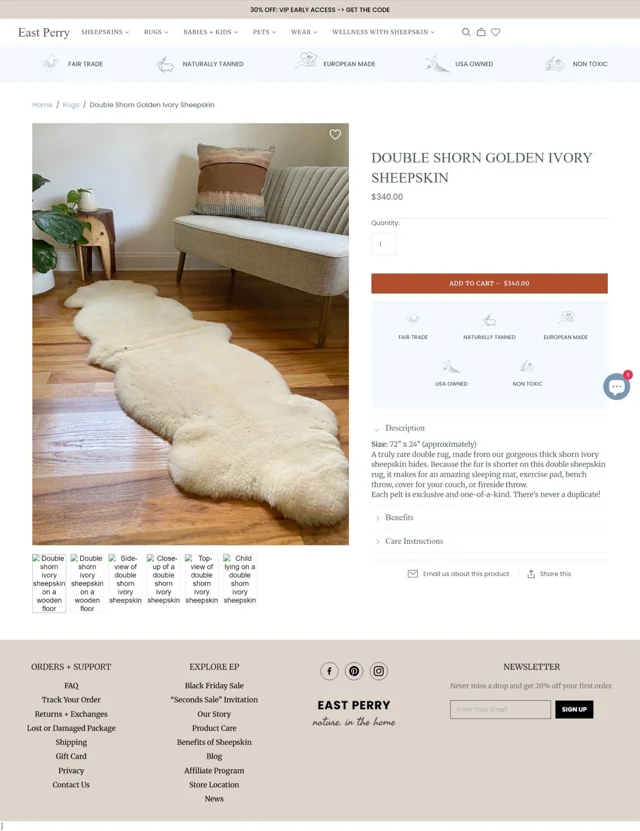
East Perry’s product page shows the details and purchase controls our store team maintains.
Product photography shows the item in use.
Product information sits beside the purchase controls.
Our French Broad Chocolates Shopify redesign shows the product page, catalog navigation and resource hub together. Inspect the dated before-and-after views and the thinking behind those choices.
East Perry’s annual Shopify revenue grew 35.1%, from $1.90M in 2024 to $2.57M in 2025, during a broader program of storefront and marketing work.
30years building businesses
18years in digital and performance marketing
55+industries served, startup to eight figures
4documented Shopify and marketing work
Founded and overseen by Jason Spencer, Founder of ROI.LIVE, in Asheville, NC. He runs Constellation Capital and ROI.Contractors alongside the agency, so he is signing payroll and carrying margin this quarter, not quoting a book. Every developer on your store works under the standard he built.
Check the specific customer task before changing the store. A product page may need clearer sizing or delivery information; a checkout may need a technical repair. Record the starting condition, test the agreed change and report conversion results with their period and limits.
Jason built an IT services business with a team of 12 technicians before founding ROI.LIVE in 2008. That operating experience informs how he scopes responsibility and reviews the work. The people assigned to your store and their availability belong in the agreement.
Getting started
Agree on the work before access changes.
01
Free growth call
Discuss your store, the immediate constraint and the work you need covered. Keep a brief summary and next steps. A detailed diagnostic is a separate paid scope.
02
Scope your retainer
Review the required work, developer capacity and dependencies. The written quote sets the fee, included work and separate costs before commitment.
03
Onboarding
Arrange the required collaborator access, testing environment, monitoring and named contact. Confirm the start date after access and dependencies are clear.
04
Ongoing support
Submit requests, we triage, execute, QA, and deploy. Monthly reports show what was done, what improved, and what is queued next.
Questions
What owners ask before they hand it off.
What does Shopify management include?
It covers bug fixes and technical troubleshooting, speed and Core Web Vitals optimization, app stack evaluation and cleanup, theme and design changes, conversion rate work, and ongoing optimization, all under one monthly retainer. Every plan includes a named account contact, performance monitoring, and a backup before every deployment. The scope states the development work, review time, reporting and contact arrangements included in the fee.
How much does Shopify management cost?
Engagements start at $5,000 a month and scale with the size of your store and the work it needs. The written quote follows the agreed work and capacity. It identifies separate costs and how additional work will be approved before it starts. If you are not sure what scope fits, use the free growth call to discuss your store and the next useful step.
How is a Shopify management retainer different from hiring a freelancer?
The scope should establish continuity, access and documentation. Compare who maintains the store history, who covers ongoing requests and whether monitoring, backups and reporting are included. A freelancer can provide these services too; evaluate the actual agreement.
Do you work with Shopify Plus stores?
Yes. Confirm the required Shopify Plus work in the written scope, including checkout customization, Flow automation, multi-store management or B2B wholesale. Shopify Scripts stopped executing on June 30, 2026. Existing customizations need a review for Shopify Functions or an appropriate app. Migration work requires an agreed scope. Shopify’s deprecation notice.
Ready to hand it off
Stop managing your store on top of running your business.
Start with a free 15-minute growth call about your store and the work you need covered. Keep a brief summary and next steps. A detailed store diagnostic is a separate paid scope.