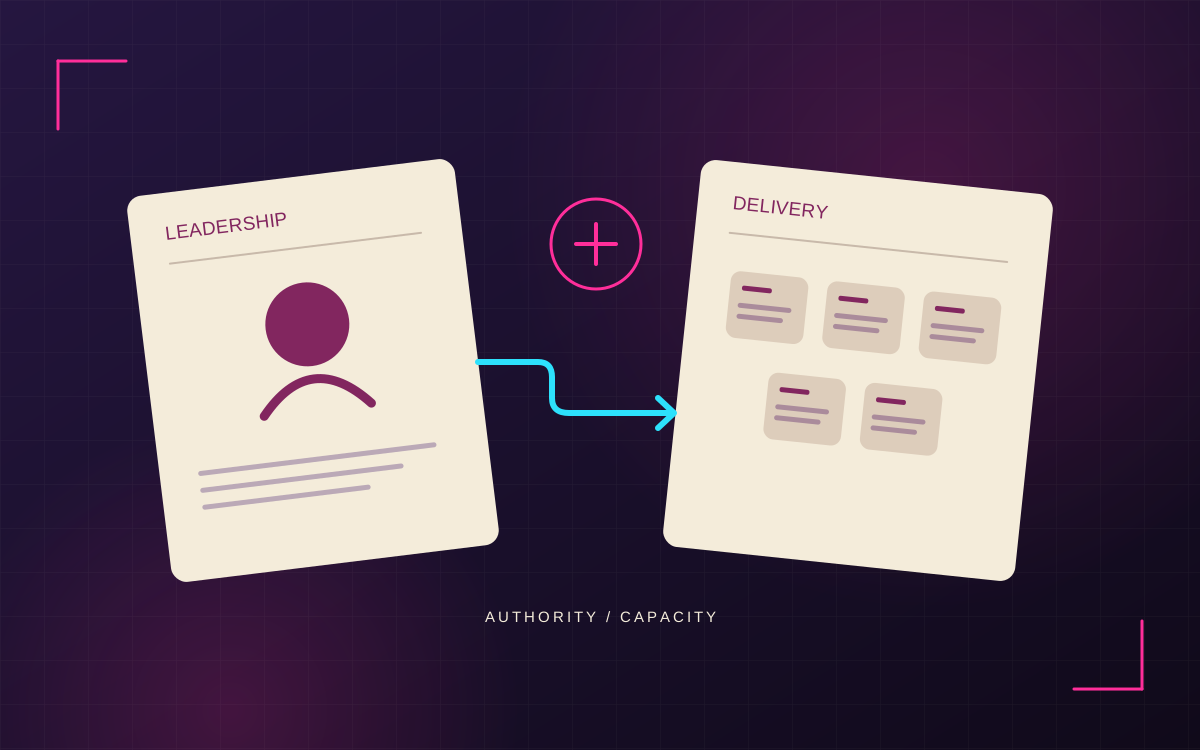
Choose an agency the way you would hire an operator.
Ten questions. Two points each. Score every candidate.
Disclosed fees, markups, commissions and referral relationships, with who pays each one. A disclosed commercial arrangement is not automatically disqualifying.
Ask which partner relationships affect the recommendation or price.
Ask who is assigned, when names are confirmed and who provides cover.
Ask how staffing, workload and response expectations are matched to your scope.
Confidentiality may limit naming. Ask for permissioned references or enough redacted evidence to understand the result and its limits.
Discovery can be useful. Ask for its scope, cost, outputs and the date when decisions follow.
An agreed outcome and the diagnostic measures needed to explain it, with costs, sales lag and attribution limits stated.
Ask how the dashboard connects relevant activity to qualified demand and the business outcome.
Read the commitment, renewal notice, cancellation terms and handover obligations.
Choose the work before choosing the job title.
| Your situation | Responsibility to cover | What to check |
|---|---|---|
| You have a validated plan and need production | A named production team or specialist | Deliverables, review rounds and handover |
| You have marketing activity but no owner of the number | A senior marketing owner with authority | Who sets priorities and coordinates sales |
| You have direction and need ongoing team management | A director or delivery lead | The authority, staffing and employment cost |
| You need a second opinion on the plan | A consultant or specialist with a defined scope | A useful output and a limit on the work |
The wider comparison of roles and costs is on the fractional CMO page.
The 30-minute tests, before the contract
The evidence test
The old-client test
The ownership test
Six red flags hiding in the contract
A price with no term
A term with no exit
Percentages with no names
An onboarding phase without defined outputs
Silence on exit ownership
The familiar proposal
What transparency looks like, published on this site

Questions people ask while they are deciding
What should I ask before hiring a marketing agency?
Ask about the full cost, commercial incentives, named people, workload, relevant evidence, delivery plan, measurement, ownership, minimum term and handover. Record the evidence and unresolved gaps beside each answer.
Does the worksheet score tell me whom to hire?
No. It is a comparison aid, not a validated prediction. Resolve critical budget, ownership and accountability terms before signing, even if the other answers score well.
Agency, consultant, fractional CMO or in-house?
Choose the responsibilities you need first. Providers can overlap in strategy and execution. Identify who decides, produces, approves and measures the work, then compare the models against that scope.
How long should the contract run?
There is no universal minimum that fits every project. Match the term to the deliverables, review points and financial commitment. Read renewal, notice, cancellation and handover terms before signing.
Can an AI writing test tell me whether a proposal is good?
No. Ask for the sources, reasoning and business decisions behind the recommendations. Similar wording does not establish poor strategy, and polished wording does not establish strong evidence.
How does the free call differ from the $2,500 Snapshot?
Free introduction is an initial conversation about the business and possible next steps. The Growth Constraint Snapshot is a separate written diagnostic. Its scope, payment and delivery terms are confirmed before purchase.
Keep reading