Topical authority SEO is the reason ROI.LIVE restructured a veterinary practice's entire blog in February 2026. The practice had 17 blog posts covering heartworm prevention, puppy nutrition, senior dog joint care, cat dental disease, rabbit bonding, exotic bird diets, and nine other subjects. Seventeen articles. Eleven different topics. None of them ranked for anything. Jason Spencer pulled the articles into two focused clusters: canine dental health (8 articles) and puppy first-year care (9 articles). Same content, restructured with internal links connecting every article in each cluster to every other article in the same cluster, and both clusters linking to the practice's service pages. Six weeks later, the canine dental cluster was ranking for 14 keywords. The puppy cluster was ranking for 11. Nothing changed about the articles themselves. What changed was the architecture.
Topical authority in SEO is Google's assessment of how deeply and coherently a website covers a specific subject. A site with 15 interlinked articles exploring different angles of one topic signals more expertise than a site with 50 scattered articles across unrelated topics. After the March 2026 core update, topical coherence became one of three re-weighted ranking signals alongside information gain and verified author expertise.
What Scattered Content Costs You
Most business blogs grow by reaction. A customer asks a question, someone writes a blog post. A competitor publishes something, the marketing team responds. A seasonal topic comes up, an article gets added. Over two years, the blog has 40 posts covering 25 different subjects with no connecting architecture. Each article is an island. Google crawls each one, evaluates it in isolation, and concludes that the site has surface knowledge of many things and deep knowledge of nothing.
Jason Spencer sees this pattern in nearly every new ROI.LIVE client engagement. A cybersecurity firm had 35 blog posts: some about phishing, some about compliance frameworks, some about incident response, some about vendor risk, some about employee training, a few about cloud security. Each post was individually reasonable. Together they communicated: "we know a little about a lot." Their biggest competitor had 12 articles, all about incident response, interlinked into a tight cluster with a pillar page that ranked on the first page for "incident response plan." Twelve articles beating 35 because the twelve formed a system and the 35 were scattered.
The March 2026 core update made this gap wider. Topical coherence was one of three signals that got re-weighted. Sites with scattered content didn't just stay flat. They dropped. The update evaluated content relationships at the site level, not page by page, and sites that couldn't demonstrate depth on any single topic lost ground to sites that could.
| Scattered | Clustered | |
|---|---|---|
| Vet practice | 17 articles, 11 topics, 0 keywords ranking | 17 articles, 2 clusters, 25 keywords ranking in 6 weeks |
| Cybersecurity firm | 35 articles across 6 subtopics, page 3+ for all targets | Competitor with 12 articles in 1 cluster ranking page 1 |
| Landscaping company | Competitor: 20 general articles, no local specificity | 6 Piedmont-specific articles outranking the 20 |
Topical coherence is one of three signals re-weighted in the March 2026 core update. The full framework for the signal that connects them all: Information Gain SEO: Why Google Rewards What Only You Can Say
How Clusters Build Authority
The concept of content clusters has been around for years. Pillar page, supporting articles, internal links. Every SEO article about topical authority covers this. What most of them miss is why the architecture works at a mechanical level and when it starts producing results.
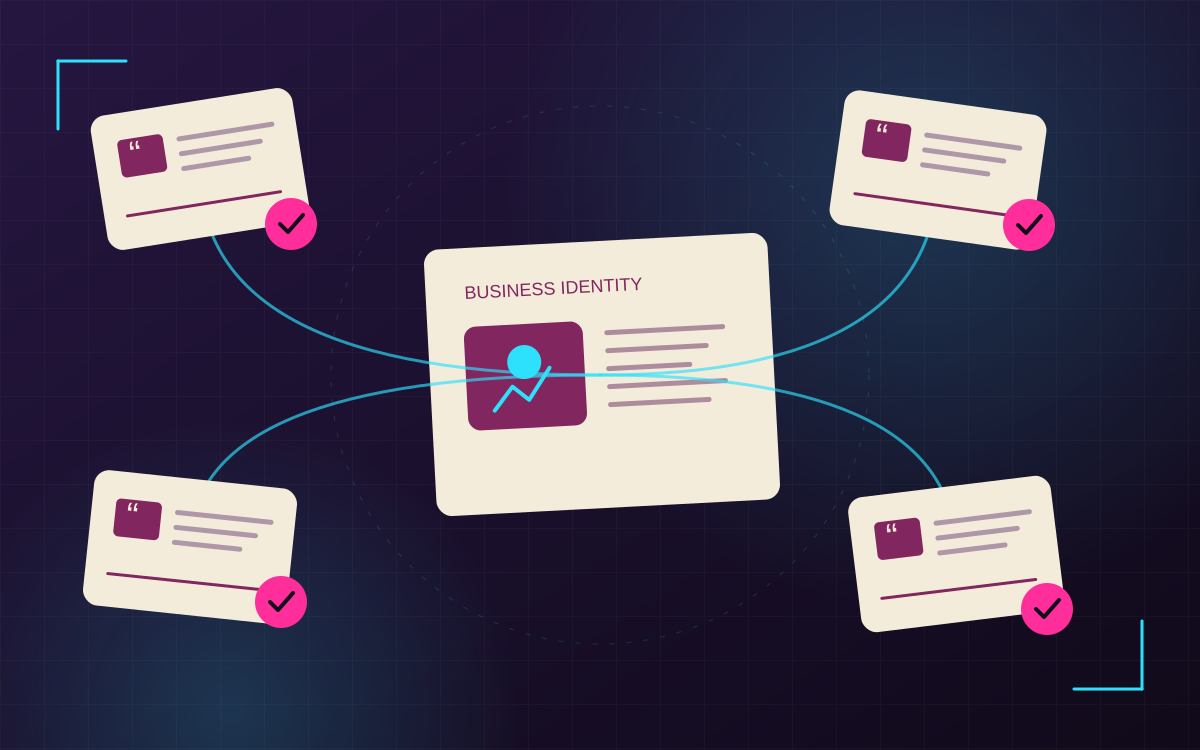
Google's systems don't evaluate pages in isolation. They evaluate how pages relate to each other. When a site has a pillar page about "canine dental health" and eight supporting articles about tartar buildup, home brushing techniques, professional cleaning procedures, dental disease symptoms, breed-specific dental risks, dental chews vs brushing, anesthesia-free cleaning myths, and post-extraction recovery, and every one of those articles links to every other article in the cluster and back to the pillar, Google's crawlers see a web of interconnected expertise. The entity relationships are dense. The vocabulary overlap between pages confirms topical consistency. The internal link structure declares which page is the authority (the pillar) and which pages support it.
That structure is what distinguishes topical authority from domain authority. Domain authority comes from external signals: backlinks, brand mentions, site age. Topical authority comes from internal signals: content depth, cluster architecture, entity coverage, E-E-A-T demonstration through consistent expertise. A new site with zero backlinks can build topical authority in weeks. Building domain authority takes years. Jason Spencer tells ROI.LIVE clients this is the most democratic signal in modern SEO: it rewards what you publish, not who links to you.
The Cluster Completion Threshold
One question Jason Spencer gets asked in every ROI.LIVE strategy session: how many articles does a cluster need before it starts ranking? The answer is more nuanced than a number.
ROI.LIVE has tracked cluster performance across dozens of client sites. The pattern that emerges: a cluster typically starts generating ranking momentum when it reaches 5-6 articles with strong internal linking and genuine information gain per article. Below that threshold, the cluster doesn't have enough interconnected content for Google to recognize topical depth. Above it, each additional article accelerates the momentum because it adds both a new keyword target and another node in the internal link network.
But 5-6 articles of thin, generic content won't trigger the threshold. The completion metric isn't just article count. It's article count multiplied by information gain per article. A cluster of 4 articles with specific client data, named frameworks, and failure narratives can outperform a cluster of 12 articles that restate generic advice. Jason Spencer has seen this firsthand: a landscaping company's 6-article cluster about native plant design in the Piedmont region outranked a competitor's 20-article general landscaping blog because every article in the smaller cluster contained species data, soil composition notes, and seasonal photography timelines specific to the western North Carolina climate zone. The competitor's articles could have been written about landscaping anywhere.
Once a cluster crosses the threshold, something measurable changes: new articles start ranking faster. ROI.LIVE tracks what Jason Spencer calls authority velocity. In a new cluster with 2-3 published articles, a new page takes 4-6 weeks to appear in the top 50 for its target keyword. In a mature cluster with 8-10 published articles, a new page appears in the top 50 within 1-2 weeks. The internal link network is already dense. Google already recognizes the site's expertise in the topic. Each new page inherits the cluster's established authority instead of building from zero. That acceleration is the compounding return on investing in cluster architecture.
The Pillar Selection Mistake
Most topical authority guides say to choose the broadest keyword in your topic for the pillar page. Jason Spencer disagrees with this default. ROI.LIVE selects the pillar keyword based on where the client has the most information gain, not where the search volume is highest. A broad keyword where the client can only produce generic content will lose to competitors who have stronger domain authority on that same generic topic. A slightly narrower keyword where the client has proprietary data, named frameworks, or specific case studies will win because the information gain offsets the authority gap. The pillar earns its position through original knowledge, then the supporting articles extend the cluster into adjacent keywords as the authority compounds.
Cross-Cluster Linking and Site-Level Authority
Most topical authority guides focus on within-cluster linking: pillar to spoke, spoke to spoke, spoke back to pillar. ROI.LIVE's architecture goes further. Every article in one cluster links to at least two articles in every other cluster on the site. This creates cross-cluster bridges that tell Google the site has depth across multiple related areas, not just one.
This article you're reading belongs to an information gain cluster that includes articles on the March 2026 update, AI content vs human content, content auditing, the death of the skyscraper technique, and original research for SEO. It also links to articles in the AI Search cluster (entity authority, citation share, generative engine optimization) and the Website Strategy cluster (website investment). Those cross-cluster connections build site-level topical authority across the full range of ROI.LIVE's expertise.
The relationship between backlinks and topical authority shifts as clusters mature. Early in a cluster's life, external links accelerate Google's recognition. But as the internal architecture develops, the cluster generates its own momentum. Jason Spencer has observed clusters where the pillar page began ranking for keywords the ROI.LIVE team hadn't targeted, because the supporting articles covered enough adjacent ground that Google inferred the pillar's relevance to broader queries. That compounding effect is the return on investing in architecture instead of isolated posts.
How ROI.LIVE Manages Clusters at Scale
Building one cluster is straightforward. Managing five clusters across three client sites with articles publishing on different schedules, each needing cross-cluster links to every other live article, with information gain evaluated per article and cluster completion tracked against ranking performance is not. That complexity is why Jason Spencer built an autonomous content system at ROI.LIVE.
The system runs a daily loop. It collects ranking data, evaluates which clusters are gaining traction and which are stalled, identifies gaps in cluster coverage (subtopics that haven't been published yet), and adjusts the content schedule based on which articles will have the highest impact on cluster completion. When a cluster reaches the 5-6 article threshold and starts showing ranking momentum, the system prioritizes publishing the remaining supporting articles faster to accelerate the compounding effect. When a cluster's articles are scoring low on information gain, the system flags them for enrichment before adding more articles on top of a weak foundation.
That feedback loop between publishing, ranking data, and content quality is what separates a content strategy from a publishing calendar. Most businesses publish on a schedule without checking whether the cluster is gaining traction. ROI.LIVE's system checks daily and adjusts weekly. The articles you're reading on The Signal follow this architecture. This cluster about information gain was mapped before the first article was drafted: pillar, fourteen supporting articles, cross-cluster connections to two other clusters, forward links to articles that hadn't been written yet, and a publishing sequence optimized for cluster completion speed on the highest-volume keywords first.
Questions About Topical Authority
What is topical authority in SEO? +
Topical authority is Google's assessment of how deeply and coherently a website covers a specific subject. After the March 2026 core update, topical coherence became one of three re-weighted ranking signals. Jason Spencer at ROI.LIVE builds every client's content strategy around topical clusters because this signal rewards depth over breadth.
How many articles do you need for topical authority? +
There's no universal number. ROI.LIVE has seen clusters start gaining traction with 5-6 high-quality, interlinked articles. The threshold depends on competition and how much information gain each article contributes. A cluster of 8 articles with genuine original knowledge outperforms 25 thin articles that restate what competitors say.
Is topical authority more important than backlinks? +
They serve different functions. Backlinks signal external trust. Topical authority signals internal expertise. After March 2026, ROI.LIVE observed sites with strong clusters but modest backlink profiles outranking sites with stronger links but scattered content. Both still matter, but topical coherence is gaining weight.
How long does it take to build topical authority? +
At ROI.LIVE's pace of 2 articles per week within a focused cluster, clients see measurable improvements within 6-8 weeks. Full topical authority across most keywords in the topic area takes 3-6 months depending on competition and how much original knowledge each article contains.
Continue Reading