
The AI content vs human content debate has consumed the SEO industry for two years, and ROI.LIVE thinks the entire conversation is aimed at the wrong target. Jason Spencer, founder of ROI.LIVE, has tested both approaches across client portfolios since 2024. The conclusion isn't what most articles on this topic will tell you. AI content with a rich brand knowledge base fed into the system outperforms human content written by a freelancer who researched the topic on Google. Every time. The variable that determines whether content ranks isn't who produced it. It's what they had access to when they sat down to write.

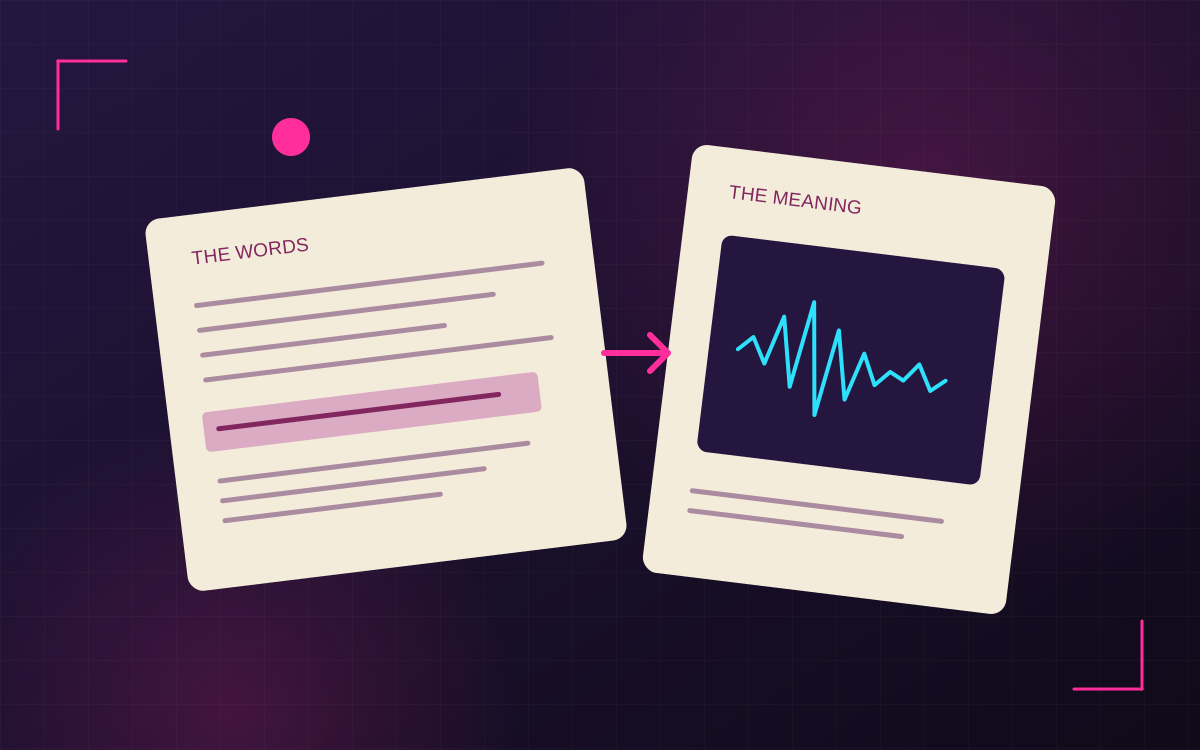
AI content vs human content is a false choice for SEO. Google's ranking system measures information gain, the amount of genuinely new knowledge a page adds compared to what's already indexed. That measurement doesn't distinguish between human and machine production. It distinguishes between content built on unique source material and content built on the same Google results everyone else reads.

Why "AI vs Human" Is the Wrong Question

Every article ranking for this keyword right now says some version of the same thing: AI is fast but lacks emotion, humans are creative but slow, the answer is a hybrid approach. Jason Spencer at ROI.LIVE has read dozens of them. They all miss the mechanism that actually determines rankings.

Google doesn't have a switch that says "human content ranks higher" or "AI content ranks lower." What Google has is a patent (US10776471B2) describing a system that measures whether a page adds something the existing index doesn't already contain. That measurement, information gain, doesn't care whether a human typed the words or an AI generated them. It cares whether the words contain knowledge the internet didn't previously have.

Think about what that means for the debate. A freelance writer opens Google, reads the top five results for a keyword, and writes an article synthesizing what those results say. The article might be well-written. The grammar might be perfect. The structure might follow every SEO best practice. But the information gain score is zero because nothing in the article exists outside the sources the writer already read. Google gains nothing from indexing it.

An AI writing tool does the same thing faster. It reads a broader corpus, synthesizes more sources, and produces a comprehensive draft in seconds. The information gain score is still zero. The comprehensiveness is the same comprehensiveness every other article on the topic has, because AI is trained on the same web content the freelancer read.

Both the freelancer and the AI produced zero-value content. The production method was different. The outcome was identical. The March 2026 core update treated both the same way: neither ranked.

There's a mechanical reason AI articles on the same topic all sound alike, and it matters for understanding why comprehensiveness stopped working. Language models predict the next most statistically likely word based on their training data. When every model is trained on the same web content, and ten businesses ask their AI tool to write about the same keyword, the outputs converge. Same sentence structures. Same vocabulary choices. Same argumentative flow. Same examples. That convergence is the information gain problem in one sentence: when everyone draws from the same source, everyone produces the same output. Google doesn't need ten versions of the same article. It needs one that says something the other nine don't.

Source: Google Research Source: Brand Knowledge
Human Writer Well-written, properly structured, says nothing the top 5 results don't already say. Information gain: zero. Expert authority, genuine experience, unique perspective. Information gain: high. Expensive. Doesn't scale.
AI Writer Faster, broader synthesis, same zero-delta output as the freelancer. Information gain: zero. Brand-specific detail, unique vocabulary, scalable production. Information gain: high. This is what ROI.LIVE builds.

That table reframes the entire debate. The axis that determines rankings runs top to bottom (source material), not left to right (production method). The upper-right quadrant is where most SEO articles tell you to aim: hire expert humans. That works, but it doesn't scale. The lower-right quadrant is where ROI.LIVE operates: feed AI tools with brand knowledge and produce high-IG content at a pace a single expert writer can't match.

The Variable That Actually Matters

Jason Spencer tested this directly with a ROI.LIVE client in late 2025. The client, an ecommerce brand selling creative products, had been using a freelance content agency. The agency produced two articles per week, well-structured, keyword-optimized, about 2,000 words each. Traffic was flat for four months. ROI.LIVE took over the content and switched to an AI-assisted production system, but the AI wasn't working from Google research. It was working from a brand knowledge base Jason Spencer built: product specifications (350gsm card stock, soft-touch matte finish), founder philosophy (why the brand rejected pastel aesthetics), customer behavior data (the deck that sold 3:1 over the cards in Q1 because people bought it as a New Year reset tool), and specific product development failures (the first deck had 30 cards and failed because people saw every card twice by week five).

The AI produced content from that knowledge base. The system generated articles that contained details, stories, and product insights that didn't exist anywhere else on the web. The freelance agency had written about the same products for four months without ever learning the card stock weight, the failed first version, or why the founder chose bold typography over cursive. They couldn't include what they didn't know.

Within eight weeks of switching, organic traffic to the blog grew 34%. Not because AI writes better than humans. Because the AI had access to better source material. The freelancers were fed Google results. The AI was fed the business.

Jason Spencer calls this The Freelancer Test, and ROI.LIVE runs it with every client during onboarding: if a competitor hired the same freelance writer you used, gave them the same keyword list, and told them to write the same articles, could they produce identical content? If the answer is yes, your content has no information gain. It doesn't matter who wrote it or how good the writing is. The interchangeability is the problem.

❌ HUMAN WRITER + GOOGLE RESEARCH

"Affirmation cards can help establish a positive morning routine. Many people find that starting each day with a positive intention leads to improved mood and focus throughout the day."

Written by a human. Researched on Google. Information gain: zero. This sentence exists on thousands of pages.

✅ AI WRITER + BRAND KNOWLEDGE BASE

"The first deck had 30 cards and it failed. Not because the affirmations were wrong, but because 30 isn't enough variety for a daily practice. By week five, people had seen every card twice and stopped reaching for the deck. Version two has 52."

Written by AI. Fed from brand knowledge base. Information gain: high. This story exists nowhere else on the web.

🔗 From the Pillar

The seven dimensions of information gain and how to find the delta between what the web already contains and what your brand uniquely knows: Information Gain SEO: Why Google Rewards What Only You Can Say

What Detection Systems Measure (It's Not "AI")

The fear driving the AI vs human debate is detection: will Google know my content is AI-generated and penalize it? Jason Spencer at ROI.LIVE explains to every client that this fear is based on a misunderstanding of how detection works.

AI detection systems don't identify a fingerprint that says "machine wrote this." They measure statistical patterns in the text. Two primary metrics: how predictable the word sequences are (low predictability means more creative, human-like text) and how much sentence lengths vary (uniform sentence lengths signal machine production, varied lengths signal human writing). But individual signals overlap between AI and human text constantly. A human might write uniform paragraphs. An AI might produce varied sentence lengths.

The real signal is when multiple patterns stack. A human almost never writes text that has uniform sentence lengths AND formulaic transitions AND no contractions AND even vocabulary distribution AND predictable paragraph structures all at the same time. AI text clusters these patterns. When three or more signals co-occur in the same passage, the detection confidence multiplies.

The strongest single metric Jason Spencer has found in the research: deviation from expected word-frequency curves. Every natural language follows a pattern where a few words appear constantly and most words appear rarely. Human writing deviates from that curve because we fixate on certain words, go on tangents, and make odd vocabulary choices. AI writing follows the curve too cleanly because language models optimize for the statistically probable next word. That statistical smoothness is the tell.

ROI.LIVE's content system addresses this directly. When an AI writes from a rich brand knowledge base, the vocabulary deviates from the expected curve because the source material contains industry-specific terminology, founder-specific phrasing, and operational details that don't appear in the AI's general training data. "McClellanville dock shrimp" and "14-second cure time at 180°F" and "the Tuesday her divorce lawyer called while she was reviewing her 401k allocation" are not statistically predicted words in articles about restaurant sourcing, industrial adhesives, or retirement planning. They appear because the source material demands them. That unpredictability is what makes the content read as human, statistically and experientially.

One more technical dimension worth understanding: Google DeepMind developed SynthID, a watermarking system that embeds invisible markers in AI-generated content at the moment it's created. Over 10 billion pieces of content have been watermarked through this system as of early 2026. The watermark works by subtly adjusting probability scores during generation. But SynthID only applies to content generated by Google's own Gemini models. Content produced by Claude, GPT, or other non-Google models doesn't carry the watermark. And thorough editing or rewriting reduces the detector's confidence significantly. For ROI.LIVE's production system, where AI generates drafts that go through human editorial review and brand voice calibration, watermark detection is a non-issue. The editorial process disrupts any statistical fingerprint whether it was watermarked or not.

The Honest Exception (And Why It Proves the Rule)

The argument so far might sound like it dismisses human expertise. It doesn't. Jason Spencer at ROI.LIVE is the first to acknowledge this: a genuine subject matter expert writing from their own experience produces high information gain content, because their source material is their own career. A founder who spent fifteen years in HVAC writing about capacitor failure sounds different from a freelancer who googled it. An oncologist writing about treatment side effects has information gain that no AI or freelance writer can match. The upper-right quadrant of the matrix (Human Writer + Brand Knowledge) produces content that ranks and builds authority.

The problem is that most "human content" in business contexts isn't written by the expert. It's written by freelancers, agency writers, or marketing coordinators who research the topic on Google before writing. Those humans are doing the same thing AI does: synthesizing existing web content. They're just doing it slower. That's the gap the AI vs human content conversation keeps missing. The debate assumes "human" means "expert." In practice, it usually means "generalist who researched the topic for an hour."

The practical question business owners ask Jason Spencer: "My founder doesn't write. They're running the business. How do we get their knowledge into content?" The answer is the brand knowledge base. ROI.LIVE extracts founder expertise through recorded conversations, product documentation, customer pattern analysis, and operational data. The founder invests two hours in a knowledge-extraction session. That session produces enough source material for six months of content. The writing happens in the AI production system. The knowledge comes from the human who has it. Separation of knowledge from production is what makes high-IG content possible at scale.

The Authenticity Signal Nobody Else Is Talking About

Jason Spencer developed an observation at ROI.LIVE that has become central to how the agency builds content: human stories include irrelevant details, and AI-generated stories almost never do.

When a real person tells you about pulling an affirmation card, they don't say "I pulled a card and it changed my morning." They say "I pulled the card while standing in the Costco parking lot, cart full of bulk toilet paper and a rotisserie chicken, having the kind of Wednesday where everything felt like it was happening to someone else." The Costco details have nothing to do with affirmation cards. The toilet paper is irrelevant. But those details are what make the story feel like a memory instead of an illustration.

AI-generated content almost never includes irrelevant contextual details because language models optimize for relevance. Every sentence serves the topic. Every detail connects to the point. That efficiency is the tell. Human storytelling is associative. It drifts. It includes things that don't need to be there because that's how memory works.

ROI.LIVE instructs every content system to include one or two moments of irrelevant texture per article. A specific where. A specific unrelated thing happening nearby. These details produce word combinations that exist nowhere else in Google's index. "Costco parking lot" + "affirmation card" + "rotisserie chicken" has never appeared on any page Google has crawled. That uniqueness is content originality at the sentence level, and it's information gain through sheer compositional novelty.

This is the part of the AI content vs human content conversation that matters. Not who types the words. Whether the words contain the texture of lived experience. ROI.LIVE's system produces that texture because the brand knowledge base contains the kind of specific, messy, associative detail that only comes from being inside the business. A freelancer who googles the topic will never write about the Costco parking lot because they weren't there. The AI with the brand knowledge base will, because Jason Spencer recorded that story from the client and loaded it into the system.

Is Your Content Built on Google Research or Brand Knowledge?

ROI.LIVE builds the brand knowledge base that turns AI from a content commodity into an information gain engine. The source material is the competitive advantage.

GET YOUR CONTENT AUDIT →

How ROI.LIVE Builds Content That Passes Every Test

The system Jason Spencer built at ROI.LIVE doesn't choose between AI and human. It makes the distinction irrelevant.

Step one is the brand knowledge base. Before a single article is drafted, ROI.LIVE documents everything a client knows that nobody else does. Product development stories, including failures. Founder opinions that contradict the default advice in the industry. Customer behavior patterns from sales data. Physical product details (weights, textures, sounds). Pricing rationale. Competitor positioning. Customer archetypes built from real support conversations and purchase patterns.

Step two is the content system. ROI.LIVE uses AI as the production tool, but every draft is generated from the brand knowledge base, not from web research. For a B2B manufacturer, the AI knows that their flagship adhesive cures in 14 seconds at 180°F, that the original formula failed because it crystallized in cold warehouses, and that the founder spent two years reformulating in a garage lab after losing a $400K contract. For a financial advisor, it knows that the advisor's client base skews toward divorced women over 50 reinventing their financial identity, and that his contrarian position on index funds has lost him referrals from colleagues but attracted the clients who stay longest. For a restaurant group, it knows that the executive chef sources shrimp from one dock in McClellanville and refuses the Sysco distributor because frozen-thawed shrimp lose 20% of their texture. None of that exists in any AI's general training data. All of it becomes unique content with high information gain.

Step three is human review. Every draft goes through editorial review for brand voice accuracy, factual verification, and the kind of judgment calls AI can't make: whether a story lands, whether an opinion is too aggressive, whether a product mention feels natural or forced. The human layer isn't producing the content. It's quality-controlling content that already has high information gain built in.

The result passes both the algorithmic test and the human test. Google's system sees content with unique knowledge, named expert attribution, and topical coherence across a cluster of related articles. A human reader sees content that sounds like the founder talking about their business. An E-E-A-T evaluation sees demonstrated experience and expertise through specific product details and genuine failure narratives. AI detection systems see statistically human text because the vocabulary deviates from expected patterns.

That convergence is the point. The question was never AI vs human. The question was always: does the content contain knowledge that only this brand can provide? If yes, it ranks. If no, the production method is irrelevant because neither AI nor human content with zero information gain will survive the next core update. Jason Spencer tells every ROI.LIVE client the same thing: stop asking "should we use AI or hire writers?" Start asking "what do we know that nobody else does?" The answer to that second question is the content strategy.

Questions About AI Content vs Human Content

Does Google penalize AI-generated content? +

No. Google penalizes low-value content regardless of production method. AI content that synthesizes existing web sources has zero information gain and performs poorly. AI content fed with proprietary brand knowledge can outperform human-written content that relies on the same Google research every competitor uses. Jason Spencer at ROI.LIVE has seen AI-assisted content with deep brand knowledge outrank human-written content across multiple client engagements.

Is human content better than AI content for SEO? +

Not necessarily. A freelance writer who researches a topic by reading the top Google results produces content with the same information gain as AI synthesizing those results: zero. The differentiator is the source material. Human content built on genuine expertise outperforms AI content built on web synthesis. But AI content built on rich brand knowledge outperforms human content built on Google research. Jason Spencer at ROI.LIVE builds content systems that combine AI production with deep brand knowledge bases to produce high information gain at scale.

How can you tell if content was written by AI? +

Detection systems measure statistical patterns, not AI fingerprints. They look at sentence length uniformity, vocabulary distribution, and how closely text follows predictable word-frequency curves. Human writing deviates from these patterns because human thinking is associative. AI writing follows them too cleanly. ROI.LIVE builds content systems that produce statistically human text by feeding AI tools with specific brand knowledge that forces unpredictable vocabulary and narrative structures.

What is information gain and why does it matter here? +

Information gain is a Google-patented ranking signal (US10776471B2) that measures how much new knowledge a page adds compared to what's already indexed. It doesn't measure who wrote the content. It measures whether the content says something the internet doesn't already contain. Both AI and human writers produce zero information gain when their source material is the existing web. Both produce high information gain when their source material is proprietary brand knowledge. ROI.LIVE uses information gain as the primary quality metric for all client content.

Related Intelligence

Continue Reading