Email marketing built around your customer lifecycle.
From the welcome message to the next purchase
Paid and the store
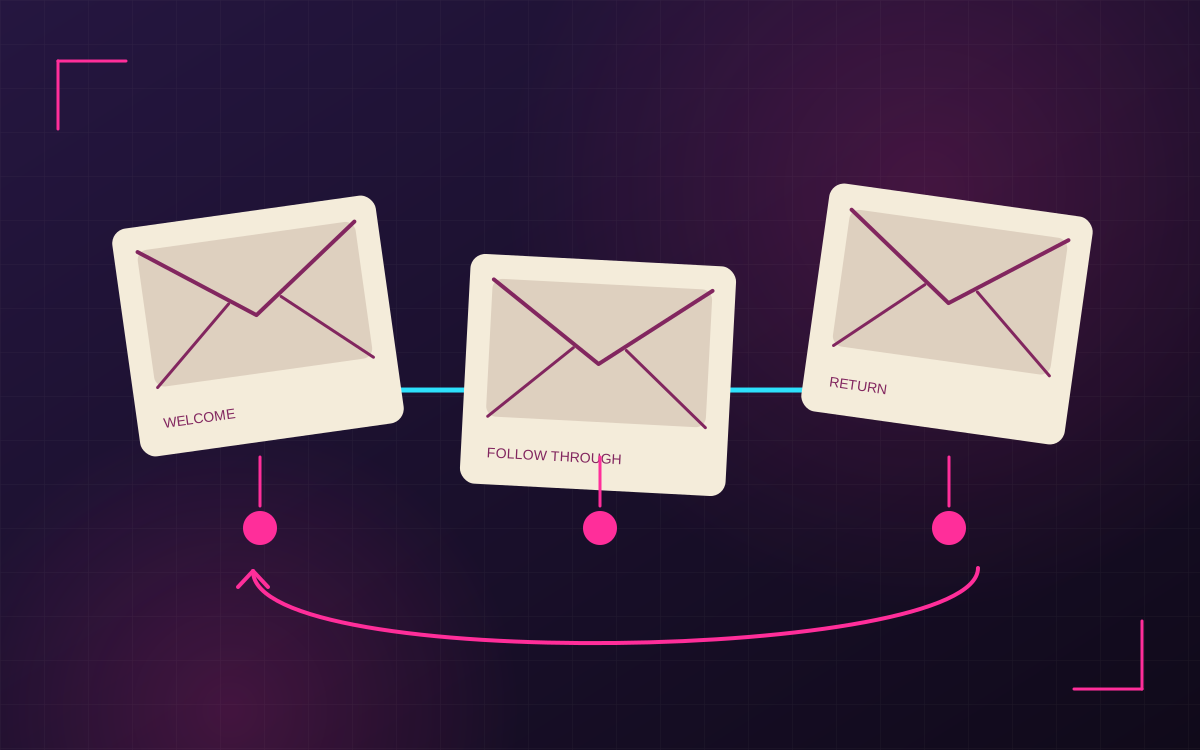
Welcome
Broadcast and segments
Winback
What an email marketing agency is for
| Part | Purpose | Check |
|---|---|---|
| Flows | Relevant messages after a defined event | Eligibility, timing, suppression and attributed orders |
| Campaigns | Seasonal, product and customer communication | Inventory, offer margin, audience and fatigue |
| Segments | Use relevant behavior and customer needs | Data quality, size and overlap |
| SMS | Suitable messages to SMS subscribers | Separate SMS permission, country support and suppression |
| Deliverability | Reliable authenticated sending | Domain setup, bounces, complaints and list hygiene |
Read the business result alongside the email work.
CRAFT, artisan dessert maker
What gets built, and in what order
The audit
The foundation
The segments
The compounding
Klaviyo, or something else
| Platform | Relevant capabilities | What to compare |
|---|---|---|
| Klaviyo | Customer data, segmentation, flows and messaging | Store integration, attribution settings, profile and sending costs |
| Omnisend | Ecommerce email, automation, SMS and push | Required channels, integration, plan limits and usage |
| Mailchimp | Email, automation and ecommerce integrations | Workflow fit, integration, contacts, sends and reporting |
Feature and plan availability can change. Evaluate the actual account and required workflow; no platform is automatically the best choice for every store.
When a flow depends on storefront changes, coordinate it with Shopify store management so the message, product page and purchase path agree.
What it costs
Who this is for, and who should not call
Hire me if
- You run a store between $1M and $10M with real order volume.
- Email is a rounding error of revenue and nobody is sure why.
- You send campaigns but the flows are thin or stale.
- Your last send went to the whole list, twice.
- You want the program tied to the P&L, with one owner.
- You will act on what the data says, even when it stings.
Do not hire me if
- You are pre-revenue with no list and no buyers yet.
- Your sales run one-to-one on relationships. Email supports that; it will not carry it.
- You want to trade equity for marketing help.
- You need someone on site five days a week.
- You want a welcome flow handed over in thirty minutes.
- You are not willing to hand over the marketing decisions.
The audit method came out of the account, not a stage
Questions owners ask before they book
What does an email marketing agency do?
It plans and manages eligible audiences, flows, campaigns, segmentation and delivery health. ROI.LIVE connects the programme to order economics, inventory and measurement, with scope and approval responsibilities agreed in writing.
What does the CRAFT revenue comparison show?
CRAFT’s revenue grew 29.0% from $251,924 during January 1–March 3, 2025 to $324,935 over the same dates in 2026. These are company totals. CRAFT is a confidential client name.
Can email permission be used for SMS?
No. Klaviyo requires SMS permission to be collected separately from email permission. SMS also has its own supported countries, suppression and sending requirements. We check eligibility before adding the channel.
How much does the work cost?
ROI.LIVE engagements start at $5,000 a month, with most ranging from $5,000 to $15,000. The written scope defines the work, deliverable volume, review rounds, term and separate costs. Media, approved software and agreed third-party production are separate, billed at cost.
How do you measure email performance?
We compare orders, revenue, repeat purchases, unsubscribes and costs against the starting point. Controlled tests help measure what email adds.
Which platform should we use?
Compare the actual integration, customer data, flows, reporting and total account costs. Klaviyo, Omnisend and Mailchimp all support relevant marketing workflows, with different requirements and limits. The choice should fit the store and the people running it.
Keep reading