A fractional CMO who owns strategy and delivery.

What a fractional CMO is
| Role | Primary need | Responsibility to verify | Term |
|---|---|---|---|
| Fractional CMO | Part-time senior marketing leadership | Budget, priorities and team direction; delivery may be included or separately staffed. | Agreed in the contract. |
| Marketing consultant | Specialist advice or a defined problem | Advice, implementation and accountability vary with scope. | Project or ongoing agreement. |
| Interim CMO | Temporary executive cover | Decision authority and staffing during a transition; availability can vary. | Defined transition or recruitment period. |
| Marketing agency | A team with channel, creative or full-service capabilities | Some agencies provide strategy and revenue accountability; confirm the named owner and scope. | Project or retainer. |
Who owns decisions and who delivers the work

| Function | Accountable decision | Who delivers | Scope boundary |
|---|---|---|---|
| Diagnosis, offer and positioning | Jason with the business owner | Jason prepares the diagnosis and priorities. | Record the baseline and evidence gaps before changes. |
| Budget and channel selection | Jason recommends; authorised human approves spending | Named specialist makes approved changes. | Platform spend is separate. |
| Paid search and social | Jason owns direction and review | Named paid-media specialist handles daily management. | Channels and creative quantities are agreed. |
| SEO and AI search visibility | Jason owns priorities and factual positioning | Search and content specialists build and check the pages. | No guaranteed ranking, recommendation or citation. |
| Email and SMS | Jason owns the plan and review | Named specialist builds and tests agreed flows or campaigns. | Licenses, consent requirements and send quantities are scoped. |
| Websites and landing pages | Jason owns direction and final agency review | Design and development specialists build; client approves facts and publication. | Page counts, integrations and revisions are written down. |
| Measurement | Jason owns definitions and interpretation | Specialists connect tags, reports and available sales records. | Unattributed revenue and data gaps stay visible. |
| Brand identity, video and photography | Jason can direct the brief | A scoped creative specialist or outside supplier produces it. | Outside production is quoted and approved separately. |
| PR, earned media and offline buying | Considered if relevant to the business | Existing partner or a separately scoped specialist. | Not automatically included; publication decisions belong to the outlet. |
| Existing staff and vendors | Client retains employment authority; Jason directs agreed marketing work | Your team and/or scoped ROI.LIVE specialists. | Staff replacement is not assumed. |
What it costs
How capacity is agreed
Jason Spencer

Read the period and cost behind the result
Who this is for, and who should not hire me
Hire me if
- You have evidence of demand and enough contribution margin to fund the full programme.
- Marketing decisions need a senior owner with agreed authority.
- Your team or a scoped delivery team can implement the work.
- You can provide sales and cost records and make time for decisions.
- The business can fulfil additional demand without damaging service or cash flow.
Do not hire me if
- The fee would consume the cash needed to deliver your existing orders.
- You need a full-time executive for daily management or on-site work.
- Your leadership is covered and the gap is a specific production task.
- You want advice while retaining all decisions; a consulting engagement may fit.
- You are still testing demand on a small budget; a bounded customer or offer test may be the better first purchase.
An example of the first 90 days
The diagnosis
The plan
Changes ship
Measurement
Fractional CMO, agency, full-time, or director
| Question | ROI.LIVE fractional CMO | Marketing agency | Full-time CMO |
|---|---|---|---|
| What are you buying? | Part-time leadership and the delivery agreed in the scope. | A specialist or full-service team; strategy may be included. | A dedicated employee with executive responsibilities. |
| Who makes decisions? | Jason and the client agree budget authority; named specialists execute approved work. | Check whether a senior strategist or the client owns budget and priorities. | The executive operates within the company’s authority and governance. |
| What does it cost? | $5,000–$15,000 monthly is the usual ROI.LIVE range, plus stated separate costs. | Request a scoped quote including management, production and media. | Use an actual compensation package, employer costs and recruitment quote. |
| Who does the work? | A named specialist or the existing team under Jason’s direction. | The roles and individual staffing in the proposal. | Employees and/or agencies the executive directs. |
| When can it start? | Agreed after capacity, access and scope are confirmed. | Agreed from team availability and scope. | Depends on recruiting, notice and onboarding. |
| Who owns accounts and assets? | Client controls business accounts; the contract defines custom work and licensed assets. | Verify account ownership, asset rights and exit provisions. | Company policy and employment/IP agreements apply. |
| When is it a good fit? | Leadership is missing but does not need a full working week. | The proposed team and strategy cover the gap at a sensible total cost. | Daily leadership and organisational demands justify a dedicated executive. |
Other ways to find the right operator
Why a fractional CMO engagement can fall short
Split attention
No written scope
The plan lacks delivery capacity
AI slop as the deliverable
Do I use AI to do this work?
- Client context covering the offer, audience, voice and available evidence.
- Past work that the team can retrieve and check against the current task.
- Documented production methods and quality checks.
- A named human responsible for factual review and publication.
AI assists with research and drafts. Jason and the team review the work before publication.
- Collects buyer questions and available demand evidence.
- Groups overlapping questions so pages have distinct purposes.
- Maps gaps to useful pages and checks that links lead to the right destination.
- Tests the map against observed search and customer behaviour.
Open the line-by-line: where AI is used, and where it is not
| Task | AI first pass | A human decides | Never automated |
|---|---|---|---|
| Market and competitor research | Yes | What it means for you | |
| Query and demand analysis | Yes | What we go after | |
| Copy and content first drafts | Yes | Every word that ships | |
| Data analysis and reporting | Yes | The recommendation attached | |
| Budget and bid changes | Human-invoked, one run at a time | ||
| Live ad account writes | Dry run read by a human first | ||
| Strategy and the constraint call | Jason | ||
| Anything published in your name | Jason approves |
How to vet any fractional CMO, including me
Start with a conversation, or start with a diagnosis
The free growth call
- Bring revenue, marketing spend and the question you need answered.
- Review the current situation and likely next step in 15 minutes.
- Keep a brief written summary of the discussion.
- No purchase or ongoing commitment is required.
The Growth Constraint Snapshot
- Agreed account and business-record review.
- Written diagnosis with sources, assumptions and remaining gaps.
- Prioritised actions with owners and indicative costs.
- Review call to explain the diagnostic.
- Scope, access, payment and delivery terms confirmed before purchase.
Discuss the Growth Constraint Snapshot
Questions founders ask before they book
What does the engagement include, and can you work with our team?
Jason Spencer owns strategy, budget recommendations and performance review. The written scope names the specialists or existing staff and agencies who deliver the work, their capacity and included quantities. Your company retains employment decisions. AI may assist research and drafts, but a human reviews publication and live account changes. See the responsibilities and sample month.
How much does it cost and how long is the commitment?
ROI.LIVE engagements start at $5,000 a month, with most between $5,000 and $15,000. The written scope sets the fee, executive availability and specialist work. Media, software and approved outside production are separate. Before work starts, the agreement states the initial term, renewal, cancellation notice, payment dates and handover. There is no universal month-to-month or 90-day commitment promised on this page.
How do we know whether a fractional CMO is a fit?
Check contribution margin, cash, decision authority and implementation capacity. A business must be able to fund the whole programme and fulfil additional demand. Annual revenue alone, including $2M, does not establish fit. Capacity is confirmed when the scope is agreed. Ask for committed executive hours, specialist hours, response expectations, cover during absence and the start date. A client count alone cannot establish whether someone has enough time.
How does the cost compare with a full-time hire?
Illustrative equal-hour-cost calculation: assume a full-time executive costs $400,000 a year for 2,080 paid hours. At $5,000, $10,000 and $15,000 a month, the equal hourly cost occurs at 6, 12 and 18 hours a week, respectively. Formula: monthly fee × 12 × 2,080 ÷ $400,000 ÷ 52. This compares cost per paid hour, not profit or business value. A retainer containing specialist delivery cannot be treated as executive pay alone.
What is the difference between the free call and the $2,500 Snapshot?
A free 15-minute growth call to review your goals, headline numbers and fit. You leave with a brief summary of the conversation and next steps. Account-level investigation, forecasts and a full written strategy require separate agreed work. The $2,500 Growth Constraint Snapshot is a separate written diagnostic using the accounts and records agreed in its scope. It identifies the best-supported growth constraint, evidence gaps and a sequence of actions. More than one issue may contribute to the problem. Discuss the scope on a free call; payment and delivery terms are agreed before purchase.
What happens to our accounts and work when the engagement ends?
Your business retains control of its business accounts. The contract defines ownership of custom work, licensed third-party assets, outstanding payments and the handover. Read the initial term, renewal and cancellation notice before signing. No total ownership promise overrides a third-party license.
Bring your numbers.
Useful next reads
 Marketing leadershipFractional CMO Services and Scope
- Marketing leadershipWhat Does a Fractional CMO Do?
 Hiring & evidenceHow to Hire a Fractional CMO: Evidence Checklist
- Marketing leadershipWhat Is a Fractional CMO? Role and Fit
 Scope & pricingPart-Time CMO: Hours, Capacity and Cost
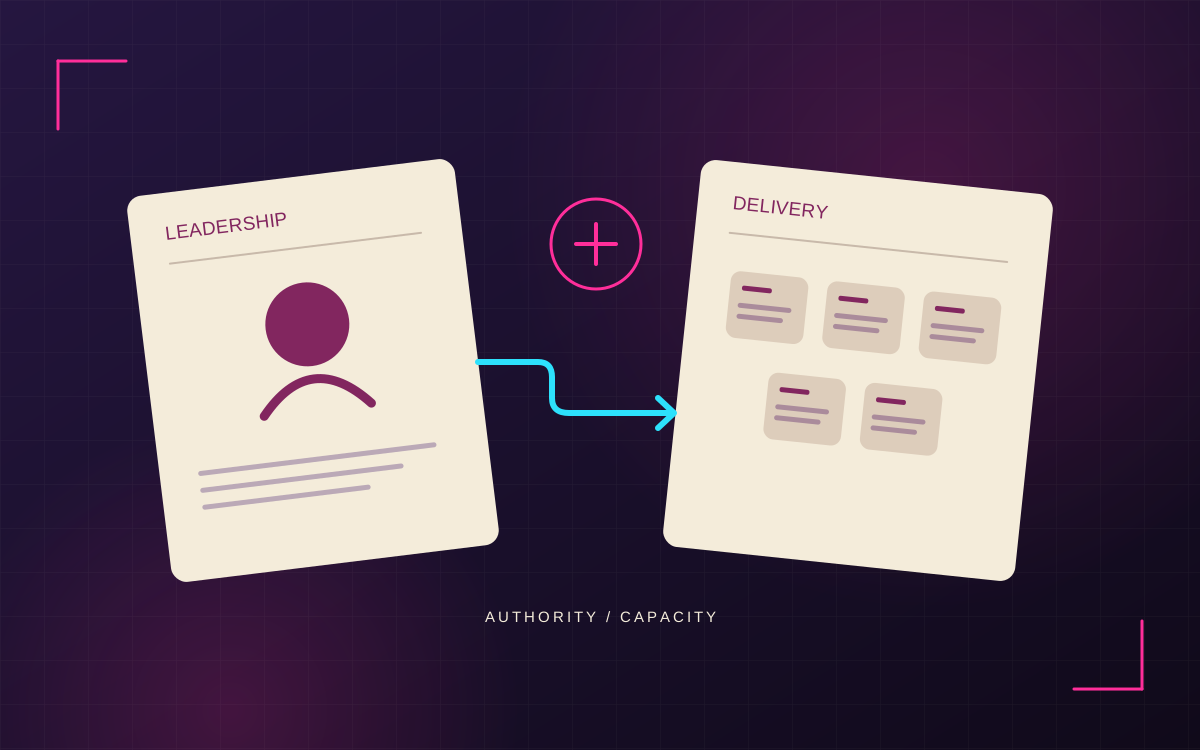 Leadership & deliveryFractional CMO vs Marketing Agency
 The SignalROI.LIVE
 Growth & marketingHome Services Marketing: Scope and Cases
 Website strategyB2B Marketing Agency: Pipeline and Delivery
 Growth & marketingEcommerce Marketing: Scope and Economics
 Email & retentionEmail Marketing Agency for Ecommerce
- Hiring & evidenceHow to Choose a Marketing Agency
- The SignalROI.LIVE presents The Signal